
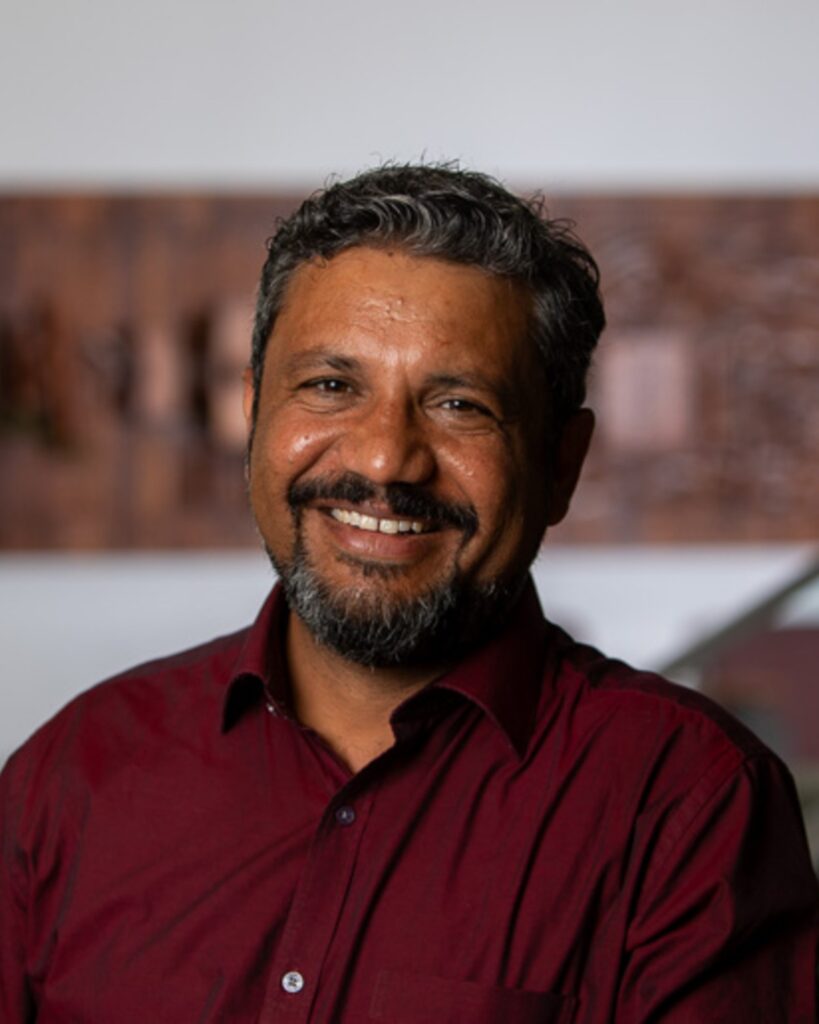
Dinesh Yadav
Professor, College of Performance, Visualization and Fine Arts, Texas A&M University
Dr. Dinesh Yadav is an interdisciplinary researcher, educator, and performance artist specializing in theatrical design. His expertise traverses various realms, including theatre, installations, events, museums, and media, merging arts, technology, humanities, and health to delve into the intricacies of performance politics. Dr. Yadav’s creations adorn global theatres, galleries, and public spaces and are featured prominently in festivals, exhibitions, and events worldwide. He has created over twenty performances and designed for more than one hundred. He has curated for the Prague Quadrennial and World Stage Design, serving as a juror for the latter.
He has authored a book alongside over twenty conference papers and has been invited as a workshop leader and masterclass instructor across India, the USA, Canada, and the UK. Chairing the Performance Design Commission of OISTAT, leading the ASPIRE Program of KCACTF Region 3, and holding the position of General Editor for Theatre Quarterly TD&T reflect his leadership in the arts community. He co-founded the non-profit Swayambhu Foundation, led its repertory company, and enriched the arts landscape with original research and performance projects. Dr. Yadav is a fellow of the National School of Drama, University Grant Commission, Ministry of Culture of India, and a Wisconsin Teaching Scholar and Fellow.
Presentation: “Two ‘Enemy’ Nation and a Dog: Performing the Border”
15 October 2026, 12:35–12:50, In-Person Session. Symposium Agenda
Abstract
Located along the historic Grand Trunk Road between Kabul and Kolkata, the Punjabi cities of Lahore and Amritsar were deeply interconnected before the Partition of British India in 1947. Linked by language, religion, commerce, family networks, and constant movement, the two cities functioned as closely connected urban and cultural spaces. Partition transformed this relationship almost overnight. The drawing of the new international boundary, formally announced through the Radcliffe Award on 17 August 1947, separated Lahore from Amritsar and triggered massive demographic transformation, communal violence, and forced migration. Amritsar’s Muslim population largely moved westward toward Pakistan, while Lahore’s Hindu and Sikh populations largely moved eastward toward India. Across the subcontinent, an estimated 14–18 million people were displaced, while estimates of those who died in Partition-related violence range widely, from hundreds of thousands to more than a million.
The railway connecting Lahore and Amritsar, passing through Wagah in Pakistan and Attari in India, became part of this landscape of displacement. Today, the same border is the site of one of the most highly choreographed displays of national identity in South Asia: the daily Beating Retreat ceremony at the Wagah–Attari border. Initiated in 1959, the ceremony is performed jointly by the Indian Border Security Force and the Pakistan Rangers and culminates in the lowering of the two national flags at sunset. Its elaborate movements (high kicks, synchronized marching, stamping, salutes, music, slogans, and reciprocal gestures) transform a geopolitical boundary into a theatrical space of national performance.
This paper examines the Wagah–Attari Beating Retreat as a form of border performance, asking how choreography, spectatorship, sound, spatial organization, costume, gesture, and ritualized repetition produce and reproduce national identities. Drawing on theories of performativity and performance studies, I consider how the ceremony simultaneously stages hostility, rivalry, masculinity, patriotism, and controlled reciprocity. Scholars have described the ceremony as a choreographed expression of political conflict and as a spectacle through which the nation and its borders are publicly performed.
By placing the contemporary ceremony within the historical memory of Lahore, Amritsar, and Partition, the paper argues that Wagah–Attari is not simply a military ritual or tourist spectacle. It is a continuously repeated performance through which a historically connected cultural landscape is transformed into, and repeatedly performs, the idea of an international border.
Keywords: Border, Performance, Partition, Lahore, Amritsar, Attari, Wagah, Independence.