
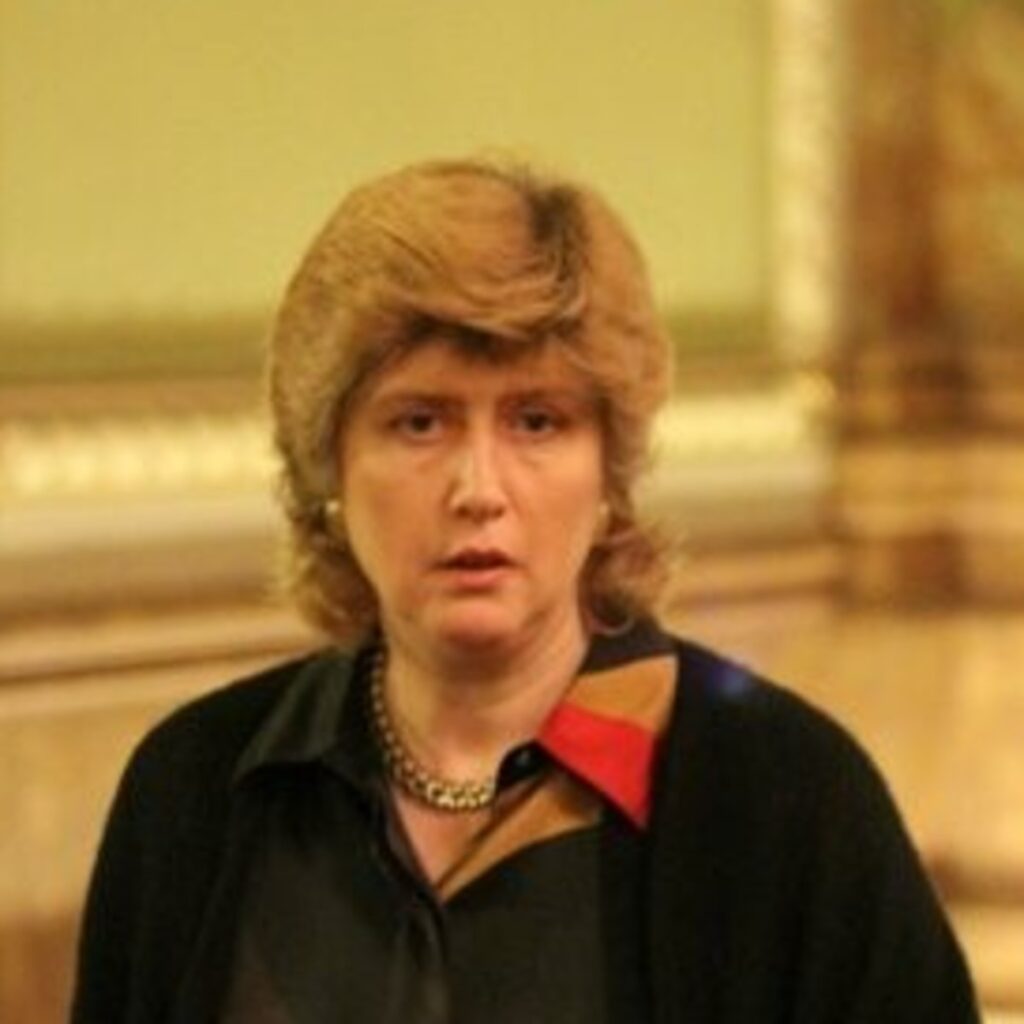
Marianna Oakley
Art Historian, Curator
Marianna Oakley is Chief Researcher at the George Chubinashvili National Research Center for Georgian Art History and Heritage Preservation, where her research focuses on the art of scenography and modern Georgian art, and Head of the center’s Academic Council. She is a visiting associate professor at the Department of Art History of Ivane Javakhishvili Tbilisi State University (undergraduate and graduate programmes).
She graduated in Art History from the Tbilisi State Academy of Arts (1981–1985) and received her PhD in 1993.
Marianna Oakley is the curator and organizer of several exhibitions, among them:
- Davit Sulakauri. Retrospective personal exhibition. Georgian National Museum, I. Grishashvili Museum of the History of Tbilisi
- “Petre Otskheli – Retrospective”, P. Shevardnadze National Gallery, Tbilisi
- Alexander Bandzeladze, “Abstraction Experiments. Beyond the Borders”
- “Georgian Stage Design”, Embassy of Georgia in Berlin, Germany
- “A Refuge for Artistic Expressions. XX Century Georgian Scenography. Paris – Berlin – Tbilisi”, European House, Tbilisi
- “Georgian Stage and Cinema Painting – Retrospective”, Pierre Cardin Center, Paris
Core works and publications:
- Teimuraz Murvanidze. Book-album, text
- Simon (Soliko) Virsaladze. Book-album, text
- Teimuraz Ninua. Book-album, text. Art book
- Koka Ignatov. Book-album, text
- “Scene Painting. Collection of the Shota Rustaveli Theatre (1920–1950)”. Album, text, with Dali Lebanidze and Elene Tumanishvili
- Dato Sulakauri. Book-album
- Prague Quadrennial, Georgian Pavilion “Woman’s Voice”. Catalogue text
- “Soliko Virsaladze”. Album-monograph, author of the text
- “Nino Chubinishvili. Artist Portrait”, journal “Georgian Antiquities”
- “Guranda Klibadze and Her Artistic World”, journal “Academy”, Tbilisi State Academy of Arts
- Guranda Klibadze. Exhibition catalogue “Monotype”, author of the text
- “Sergo Kobuladze and His Theatrical World”, conference on modern and contemporary Georgian art “Heritage and Modernity”, Tbilisi
- “20th Century Georgian Stage Design: Tradition and Innovativeness”, international conference of modern and contemporary art “Memory, Art and Art History in the Search for Identity”
Marianna Oakley has written many articles on theatre, art exhibitions, and modern and contemporary Georgian art. She is a member of OISTAT (International Organisation of Scenographers, Theatre Architects and Technicians) and ICOM (International Council of Museums).
Presentation: “Georgian Scenography: From the History of Theatrical Costume. Shift of Time or Continuation of Tradition”
15 October 2026, 14:30–14:45, In-Person Session. Symposium Agenda
Abstract
Each era is characterized by its corresponding set of problems, stylistics, and conceptualization. In certain instances, it seemingly continues a traditional line in terms of form, yet conceptually offers a fresh interpretation of a universal theme. The old stands face-to-face with the new, giving birth to a different world-perception and a new creative consciousness.
Art has always been closely intertwined with political, social, and cultural realities, confronting them with innovative changes and new challenges. One of the most significant themes brought to the fore in the 20th century, both within art history and in a broader historical context, is the issue of gender identity.
The definition of the woman’s place and role in Georgia has undergone significant changes, a process that is still ongoing. The woman has stepped out of the traditional social environment and taken their stand beside men.
In the path of its historical development, Georgian fine art has assigned a significant place to the female artist, and theatrical art is no exception. At this stage, a paradigm of self-reflection in artistic thinking can be clearly discerned in their work, in terms of uniting the characteristics of old and new art, which acquires a fitting resonance with contemporaneity.
This notion was evidenced by the Georgian Pavilion presented at the 2015 Prague Quadrennial (PQ), which entirely reflected the work of contemporary female stage designers. The works of the twelve artists exhibited at the display created a comprehensive picture of the trends emerging in Georgian scenography and theatrical costume design at the beginning of the 21st century. What has the subsequent decade brought? Has the costume acquired a character-driven function, or has it remained merely an attire of the protagonist, an element of the character’s artistic and aesthetic image and decoration?